
Drive the future of flight and beyond. U.S. companies developing rocket engines, hypersonic systems, next‑gen propulsion or advanced manufacturing for launch vehicles may qualify for the federal R&D Tax Credit under IRC § 41 (plus potential state incentives). endeavoradvisors.com+1


Examples of qualifying activities
- High‑thrust engine development: New chamber geometries, novel injectors, advanced cooling, additive‑manufactured parts.
- Reusable launch‑stage technology: Designing recovery/landing systems, evaluating structural fatigue cycles, rapid‑turnaround operational tests.
- Hypersonic propulsion: Scramjet or dual‑mode engines, high‑Mach flight systems.
- Next‑gen propellant/feed systems: Green propellants, cryogenic feed systems, novel injector technologies.
- In‑space maneuvering propulsion: Electric/hybrid thrusters, station‑keeping systems for large space structures, deep‑space maneuvering.
- Full‑lifecycle testing & qualification: Burn‑tests, vibration, thermal cycling, acoustic/engine‑noise tests, failure‑mode experimentation.
What qualifies as R&D in Jet Propulsion & Rocketry?
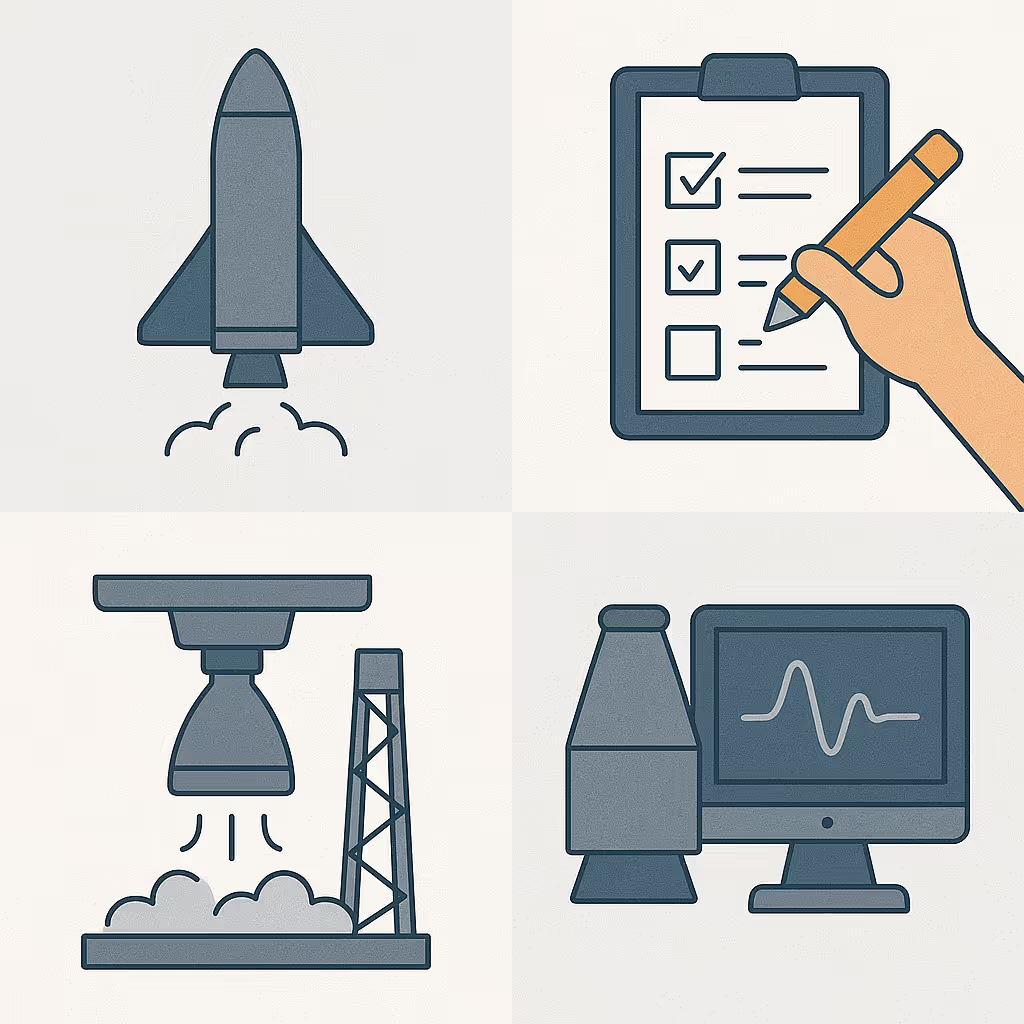
Your work may qualify if it:
- Targets a permitted purpose — e.g., designing a reusable launch stage, a scramjet/ramjet architecture, additive‑manufactured engine components, or improving fuel/injector systems.
- Addresses technical uncertainty — such as: “Will this high‑temperature material survive repeated burn cycles?”, “Can we achieve stable combustion with a new propellant mix?”, “Will this reusable engine meet turnaround time targets without excessive maintenance?”
- Uses a process of experimentation — including engine test‑stands, burn‑tests, simulations of combustion cycles, structural/thermal testing, redesign based on failed trials.
- Is technological in nature — grounded in propulsion engineering, fluid/combustion dynamics, materials science, software/control systems, aerodynamic/thermodynamic modelling.
Qualified Research Expenses (QREs)
Roles commonly involved
- Propulsion system engineers, combustion specialists
- Materials scientists working on high temperature/low‑weight materials
- Test‑stand operators, control‑system engineers
- Software simulation engineers, data‑analysis scientists
What does not qualify
- Routine engine manufacturing without innovation or testing of new cycles
- General operations, marketing or administrative tasks
- Deployment/production of proven propulsion systems with no experimentation
- Capital purchases unrelated to defined R&D (e.g., building a factory not tied to R&D)
Compliance and Documentation
Following the One Big Beautiful Bill Act (OBBBA) signed July 4, 2025, §174 now allows immediate expensing of domestic research expenses for tax years beginning on or after January 1, 2025. Taxpayers may also elect optional amortization under new §174A. Foreign research expenses must still be amortized over 15 years. This is separate from the §41 credit but impacts overall tax planning.
Documentation Best Practices
- Project objectives with clear technical uncertainty
- Engine test‑stand logs, simulation vs physical burn results
- Version control, design‑iteration logs, engineering change records
- Time‑tracking of engineers/technicians, cost‑allocations Proper documentation supports the four‑part test and strengthens audit readiness.
Frequently Asked Questions
Yes — if they develop new propulsion systems, reusable launch technology, hypersonic vehicles or conduct experimental tests under technical uncertainty.
Engineer/test staff wages, prototype supplies, simulation software, contract research tied to experimentation.
Routine production/maintenance, use of standard engines without innovation/testing, purely administrative tasks.
Savings vary by project size and scope, but many companies in this field claim sizable credits when properly documented.
Maintain logs of test results, simulation data, time‑sheets, design‑change history and proof of experimentation and uncertainty.
Next Steps

Use our calculator to estimate your potential federal and state benefits

Schedule a consultation to structure your row crop research activities
If you are innovating in agriculture, you may already be doing R&D. Let's make sure you are rewarded for it.
Contact Strike Tax Advisory
Ready to maximize your R&D tax credits? Get in touch with our team of experts.

How much could I get back for
Jet Propulsion & Rocketry
?


