
Accelerate innovation in vehicle and component manufacturing. Automotive OEMs, suppliers and modulers routinely develop new powertrain systems, chassis designs, connected/embedded software, advanced manufacturing processes, automation, lightweight materials and emissions‑control systems — many of which meet eligibility for the federal R&D Tax Credit under IRC §41 and complementary state‑level incentives.
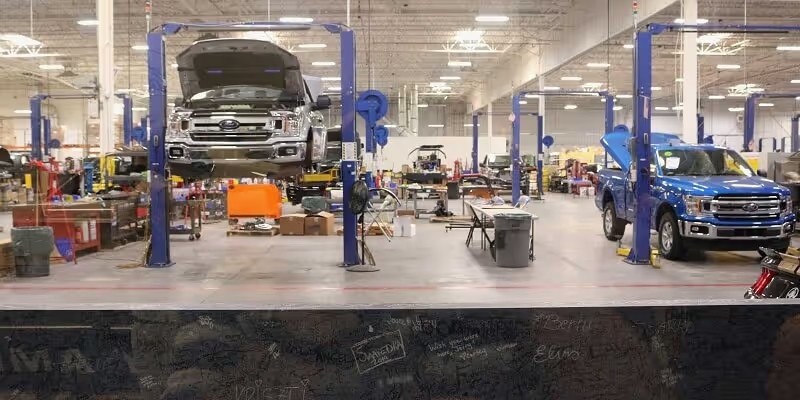

Examples of qualifying activities in automotive & OEM manufacturing
- New Vehicle Subsystem Development Designing and testing a next‑generation drivetrain, electric vehicle inverter, fuel‑cell stack, battery management system, advanced infotainment or driver‑assist module.
- Lightweight Materials & Structural Design Testing alternative alloys, composites, hybrid materials, redesigning structural components for crash/ fatigue performance, simulation of new bonding or welding techniques, validating by physical testing.
- Manufacturing Process Innovation Implementing robotic assembly, vision inspection, flexible manufacturing cells for variable SKU volumes, adaptive tooling, quick‑changeover lines, process simulation and pilot runs to reduce defects, scrap, cycle time or energy use.
- Emissions, Safety & Regulatory Trials Developing systems to meet new regulatory standards (e.g., Euro/NHTSA), validating new sensors or control strategies, structural crash test prototypes, emission‑control or after‑treatment technologies.
- Connected/Embedded Software & Hardware Integration Developing or improving ECUs, V2X communications, sensor fusion algorithms, firmware validation, hardware‑in‑the‑loop (HIL) testing, integration of software into hardware systems.
What qualifies as R&D in the automotive & OEM sector?
To qualify, your automotive/OEM activities must:
- Aim at a permitted purpose — such as a new or improved vehicle subsystem (battery, drivetrain, sensor network, infotainment), a lightweight material or structural design, an advanced manufacturing process/fixture, improved emissions/fuel‑efficiency or connected vehicle software.
- Tackle technical uncertainty — for example: “Will this new battery pack design meet durability, thermal and safety standards in a 200 k‑mile vehicle?”, “Can we integrate a new driver‑assist sensor array into an existing ECU network without unacceptable latency?”, “Will the new stamping process using a lighter alloy produce tolerances and fatigue life matching current standards?”
- Use a process of experimentation — pilot build, prototype testing, simulation/CAx modelling, materials trials, manufacturing line trials, failure/fallback testing, measurement of durability/fatigue.
- Be technological in nature — work grounded in automotive engineering, electrical/electronic engineering, materials/metallurgy, software/firmware development, mechanical design, advanced manufacturing/robotics or vehicle systems integration.
Qualified Research Expenses (QREs)
Within the automotive/OEM space, qualifying expenses include:
Roles commonly involved in qualifying activities
- CAE / Simulation engineers modelling vehicle structures or systems
- Materials/metallurgy engineers testing alloys, composites or joining techniques
- Controls/software engineers developing embedded systems, firmware, HIL/vehicle integration
- Manufacturing/process engineers designing or piloting automated lines, sensor/vision systems
- Test engineers conducting durability, environmental, crash or regulatory tests
- External research labs performing specialised materials/structural or sensor testing
What does not qualify
- Routine production of vehicle components without experimentation (e.g., just stamping parts using known processes)
- General business operations: sales, marketing, administrative support, standard engineering for proven products
- Applying existing manufacturing methods to new vehicle models without technical uncertainty or experimentation
- Land acquisition or facility expansion solely for scaling manufacturing (unless research/test program is tied)
Compliance and Documentation
Following the One Big Beautiful Bill Act (OBBBA) signed July 4, 2025, §174 now allows immediate expensing of domestic research expenses for tax years beginning on or after January 1, 2025. Taxpayers may also elect optional amortization under new §174A. Foreign research expenses must still be amortized over 15 years. This is separate from the §41 credit but impacts overall tax planning.
Documentation best practices for automotive/OEM R&D:
- Project briefs outlining performance targets (e.g., “Reduce battery pack weight by 20%, maintain 800 cycle life, meet safety spec X”)
- Prototype build/test logs: simulation runs, CAE modelling reports, physical test data, failure analysis, iteration logs
- Time‑tracking of R&D engineers/test teams; payroll records for supporting personnel
- Manufacturing or process‑trial run sheets: cycle time data, defect/scrap rates, change‑over logs, line layout modifications
- Version history of designs, alternatives considered, test results including failed trials (all part of experimentation) Maintaining robust documentation is key to satisfying the four‑part test under §41 (permitted purpose, technical uncertainty, process of experimentation, technological in nature).
Frequently Asked Questions
Yes — if your company is working on new or improved vehicle systems, materials, manufacturing processes, embedded/connected software, safety/emissions trials, or other technical‑innovation activities rather than purely routine manufacturing.
Wages for development/test engineers, supplies for prototypes/trials (materials, sensors, test fixtures), software or analytics tools used in experimentation, and third‑party lab or specialist vendor services tied to research.
Designing and testing new drivetrains or battery systems; automating assembly lines for lightweight components; developing embedded vehicle software; validating new crash or emissions technologies; prototyping advanced materials for structural weight reduction.
Routine production of known components, standard manufacturing scale‑up without technical uncertainty or new methods, general admin/marketing tasks, standard machine purchases for manufacturing without a research project.
The credit value varies widely depending on project size and documentation; many automotive manufacturers and suppliers who properly identify and document R&D activities claim credits of up to ~22% of qualified research expenses (federal + state combined) when fully utilized.
Maintain detailed project objectives/hypotheses (e.g., “Can the new structural composite meet the fatigue life of 1.5 million cycles while reducing mass by 15%?”), track simulation/test results, version logs of prototypes, employee/project time‑records, process‑trial run sheets, change‑over or tooling data, scrap/yield metrics, and supportive internal summaries.
Next Steps

Use our calculator to estimate your potential federal and state benefits

Schedule a consultation to structure your row crop research activities
If you are innovating in agriculture, you may already be doing R&D. Let's make sure you are rewarded for it.
Contact Strike Tax Advisory
Ready to maximize your R&D tax credits? Get in touch with our team of experts.

How much could I get back for
Automotive & Original Equipment Manufacturers (OEMs)
?


